
Observe
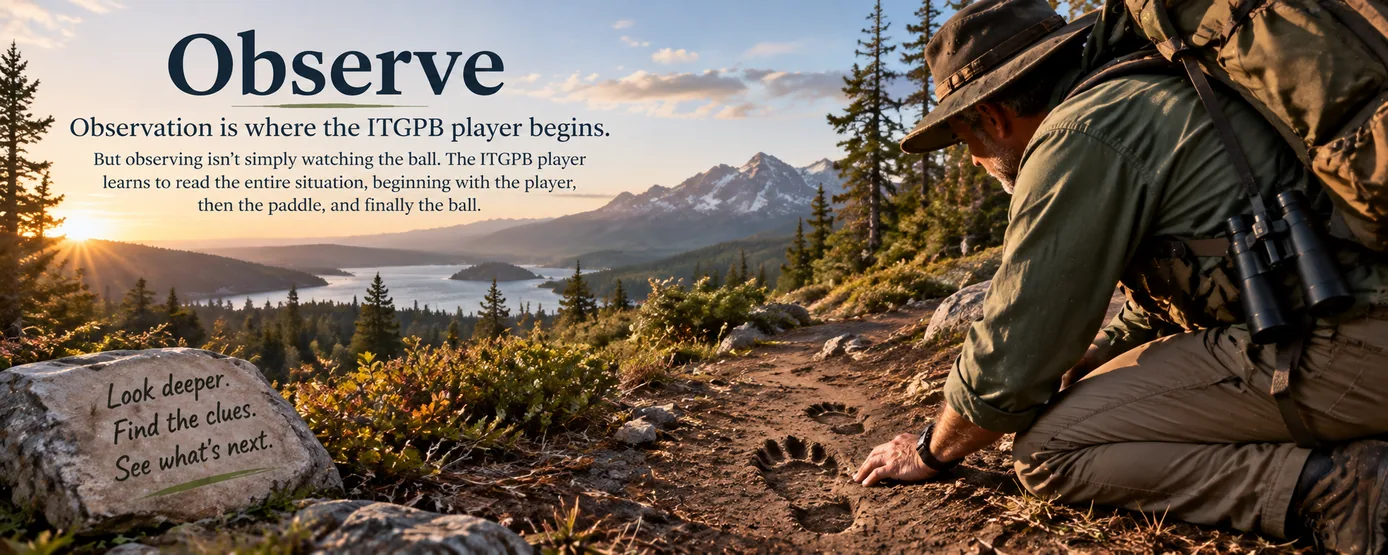
Observation is where the ITGPB player begins.
But observing isn't simply watching the ball. The ITGPB player learns to read the entire situation, beginning with the player, then the paddle, and finally the ball.
Read the Player
Before the ball is struck, the opponent is already giving you information.
Where are they positioned? Are they balanced? Where are they holding their paddle? Is the paddle up and ready, or hanging at their side? Are they choking up on the handle or holding it at the end? Are they using their non-paddle arm to help with balance and preparation?
Even their expression can tell you something. Do they look confident and prepared, or do they look uncertain, uncomfortable, or afraid?
These observations don't tell you exactly what the opponent will do. They give you clues about what they might be able to do from their current position.
Read the Paddle
While reading the player gives you possibilities, the paddle gives you the most immediate information about what is actually about to happen.
The ITGPB player watches three things:
Paddle speed. Paddle direction. Paddle angle.
These are the true markers of what is about to happen to the ball.
The speed and movement of the paddle provide clues about the pace and direction of the shot. The angle of the paddle face provides another important clue about where and how the ball is likely to travel.
The better you become at reading the paddle, the less you have to wait for the ball to tell you what is happening.
Read the Ball
Once the ball leaves the paddle, the ITGPB player continues to observe.
Now the ball provides more information:
The player isn't simply watching where the ball is. They are beginning to understand where it is going.
That information becomes the foundation for the next step:
Anticipate
Observation gives the ITGPB player information.
Anticipation turns that information into a prediction.