
Watch two pickleball players during a rally. One appears comfortable and focused, moving with purpose and making deliberate shot choices. Their shots create opportunities, often without a great deal of unnecessary effort. The other is frequently out of position, hitting off-balance, making poor shot choices, and becoming frustrated with themselves or things happening around them.
Both players are playing the same game, on the same court, under the same rules. So, what accounts for the difference?
Perhaps it's not simply how well they can hit a pickleball, but how much they recognize and understand about the game unfolding in front of them. This brings us to an interesting concept: PAQ — Pickleball Awareness Quotient.
Knowing What to Do Isn't the Same as Recognizing What to Do
Most pickleball players spend considerable time learning techniques, practicing shots, and developing strategies. Yet knowing how to execute a shot doesn't necessarily mean recognizing when or why to use it. Even experienced players can struggle with this distinction.
Sometimes an opponent seems to have a plan, repeatedly creating situations that put us on the defensive. We recognize that we're being attacked, but finding a way to counter what they're doing becomes difficult. Other times, everything seems to come together. We're thinking clearly, making good shot choices, and creating opportunities without consciously following a particular plan. The game seems to flow naturally.
So, what changes?
Consider a player who loses five consecutive games. Before the sixth game, a partner offers one simple suggestion: concentrate on making your third-shot drops. Suddenly, those drops begin working, the rest of the player's game comes together, and they win comfortably. The player's abilities haven't suddenly changed. Their attention has.
Now consider the opposite experience. A player begins a session making excellent shots without thinking too much about technique. Then a few mistakes occur. The player begins analyzing what's wrong, questioning their mechanics, and trying to correct their performance. Instead of becoming more effective, the game becomes increasingly difficult because their attention has shifted away from the game and toward themselves.
Physical fatigue can complicate matters further. As players become tired, maintaining concentration becomes harder. They may even stop noticing important information, such as the moment the ball contacts an opponent's paddle.
The problem isn't always a lack of knowledge, technique, or experience. Sometimes the problem is simply where our attention is directed — and what we're no longer noticing.
What Is Pickleball Awareness Quotient?
We're familiar with IQ, a score intended to assess aspects of human intelligence. But what if we had a way to think about a player's awareness and understanding of pickleball? Let's call it PAQ — Pickleball Awareness Quotient.
PAQ isn't an official rating or a numerical score. It's a conceptual, or virtual, measure of a player's ability to recognize what's happening during a game, understand what it means, and respond appropriately.
At its foundation, PAQ develops through connections between two important concepts: Situational Awareness and Mental Representations. Situational Awareness enables us to recognize what's happening on the court, while Mental Representations are the patterns and understandings we've developed through observation, practice, and experience.
As those connections develop, we begin recognizing familiar situations and responding to them without consciously analyzing every decision. We may recognize opportunities sooner, anticipate opponents' intentions, and adapt our game when something isn't working.
But PAQ involves more than recognizing shots and anticipating where the ball is going. It also involves maintaining our attention, managing distractions, understanding how our emotions influence our decisions, and recognizing what our opponents are trying to accomplish.
Does having a high PAQ mean we'll win every game? Of course not. Sometimes our opponents simply play better. Other times, fatigue, frustration, or distractions interfere with our ability to recognize and respond to what's happening.
However, the more situations we learn to recognize and the more mental representations we develop, the more possibilities we may have available when the game becomes difficult.
PAQ isn't about knowing how to win every game. It's about developing the awareness and understanding that may help us find a way to play better, even when things aren't going our way.
Why Does PAQ Matter?
Learning how to hit a pickleball is important, but successful shot execution often begins long before our paddle contacts the ball. It begins with recognizing what's happening.
Consider a player who has practiced a particular shot hundreds of times and can execute it consistently during drills. Yet during a game, that same player struggles to make the shot. The problem may not be their swing, grip, or paddle path. Perhaps they simply recognized what was happening too late.
Late recognition leads to late movement. Late movement leads to poor positioning, leaving less time to prepare and execute the shot properly. What appears to be a technique problem may actually be an awareness problem.
This is why one of the fundamental principles of IT Guy Pickleball is "Beat the ball to the bounce." The earlier we recognize what's happening, the more time we have to get into position, establish our balance, and make an appropriate shot.
But recognizing what's happening is only part of the process. We must also understand what we're seeing, and this is where Situational Awareness connects with Mental Representations.
We develop new skills through repetition. We attempt something, experience failure, make adjustments, discover what works, and repeat until successful execution becomes increasingly reliable. Developing PAQ follows a similar process, except we're learning to recognize situations as well as execute shots.
Through observation and experience, we begin associating an opponent's movements, paddle position, and ball trajectory with familiar patterns. We learn to anticipate what may happen next and recognize possible responses. Over time, those connections become stronger, and situations that once required considerable thought begin to feel familiar.
We don't necessarily have to think through every detail because our experience helps us recognize what to do.
Sometimes the most important skill isn't how we hit the ball. It's recognizing what's happening early enough to be ready when the ball arrives.
How Do We Develop PAQ?
Developing our Pickleball Awareness Quotient begins with learning what to observe. One of the most important things we can learn to recognize is the moment the ball makes contact with our opponent's paddle. That moment provides information about the incoming shot. The sooner we recognize what's happening, the sooner we can anticipate where the ball is going and begin moving into position.
Beat the ball to the bounce.
We can begin developing this ability with a simple exercise that removes the distraction of trying to hit the ball. Watch your opponent make contact, recognize where the ball is traveling, move into position, and catch the incoming ball or allow it to contact your non-hitting hand. Instead of worrying about making a shot, concentrate on recognizing what's happening and arriving in the right position.
As we practice recognizing the incoming ball and arriving in position early, we begin developing the awareness needed to beat the ball to the bounce. Once we can do this consistently, we introduce a specific shot from that position. As our execution becomes more reliable, we begin learning additional shots from the same position, gradually developing more possibilities.
When we arrive early, we have more time to recognize our options and make deliberate decisions. We can begin choosing shots based on what we observe rather than simply reacting to the incoming ball. But the process doesn't end when we hit our shot. We observe our opponent's response, anticipate where the next ball is going, and prepare to beat that ball to its bounce.
Observe → Anticipate → Act → Observe Again.
I've noticed that the players who give me the most trouble often appear to arrive early. They have time to make shots that look easy, and they remain calm while doing it. When I successfully beat the ball to the bounce myself, it feels like I'm playing a different game. I see my options sooner, make decisions earlier, and often recognize my opponent's next shot in time to prepare for the next bounce.
That's the experience we're trying to develop. Not simply the ability to hit more shots, but the awareness to recognize situations sooner, understand our options, and respond with purpose.
We develop PAQ one connection at a time, through observation, repetition, and experience.
The Aha! Moment — When Awareness Becomes Understanding
Sometimes the most meaningful improvements in pickleball don't come from learning a new shot. They come from recognizing something we already know.
I experienced this while teaching a clinic about using a loose grip to absorb and redirect hard shots from bangers. During a demonstration, I asked a student to hit fast forehand groundstrokes toward me from the baseline. My objective was to show how a loose grip could absorb the incoming pace and produce a soft return into the kitchen.
But something unexpected happened. I had my own Aha! moment. Even though I understood the technique well enough to teach it, I was struck by just how easy it was to drop those hard shots softly into the kitchen. The experience reinforced something I already knew.
Later, during an actual game, I encountered a similar situation. An opponent at the baseline drove a hard forehand groundstroke toward me. I recognized the situation and, without consciously thinking through the technique, used a loose grip to absorb the shot and drop the ball into the kitchen. I won the point, and my reaction was simply, "Aha!"
That moment wasn't about discovering a new technique. It was about recognizing a familiar situation and responding naturally with something experience had taught me.
Situational Awareness recognized the opportunity. A Mental Representation provided the response.
That's the connection we're trying to develop through PAQ. Not every improvement produces a dramatic Aha! moment. Sometimes we simply notice that we're arriving earlier, feeling more comfortable, or making better decisions.
We won't always recognize the right response or execute it successfully, but as these connections develop, situations that once seemed difficult may begin to feel familiar. Perhaps one of the clearest signs that our PAQ is developing is when we no longer need to think so much about what to do next.
We simply recognize what's happening and respond.
Building Your PAQ Toolbox
Developing your Pickleball Awareness Quotient isn't about collecting more techniques or simply playing more games. It's about becoming a Learning Player.
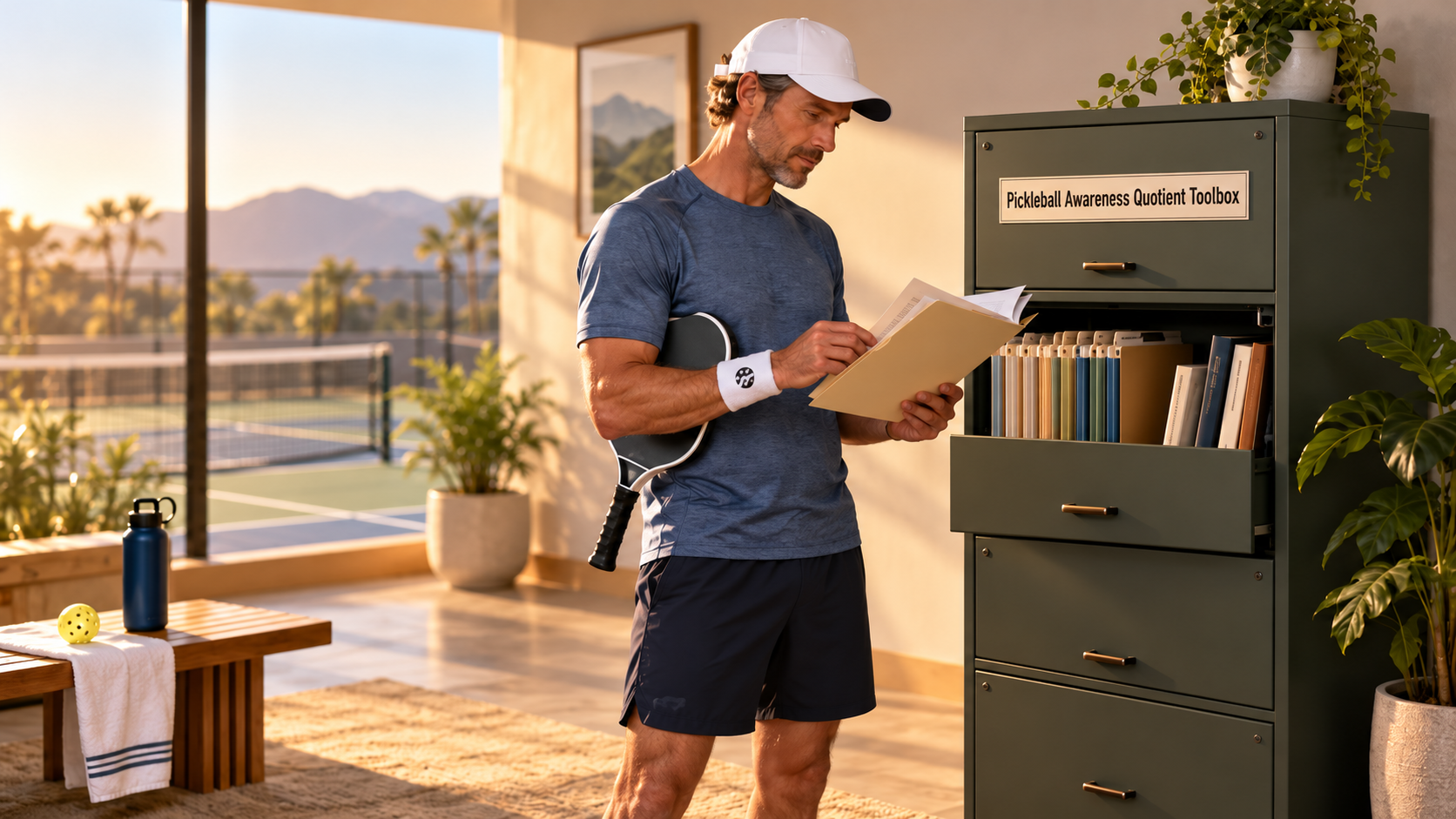
PAQ develops through the connections we build between Situational Awareness and Mental Representations. The more situations we learn to recognize, and the more experience we gain responding to them, the more possibilities we have available during play. Think of those possibilities as tools in your PAQ Toolbox.
Every opponent's habit you recognize, every situation you learn to anticipate, and every effective response you discover becomes another tool you may be able to use in the future.
But building that toolbox requires becoming an active observer. Don't simply step onto the court and return the ball over the net. Look for clues. Observe your opponents' movements, paddle preparation, positioning, and shot selections. Look for habits, weaknesses, and situations that may create opportunities.
Pay attention to what happens when you make particular shots and how your opponents respond. Learn to recognize situations you've encountered before. When something doesn't work, don't simply become frustrated and try harder. Become curious about what happened, what you missed, and what you might recognize sooner the next time.
You won't always find the answer, and you certainly won't win every game. But every game offers opportunities to observe, discover, and learn.
The objective isn't simply to become a player who knows more shots. It's to become a player who recognizes more situations, understands more possibilities, and increasingly knows what to do about them.
Build your PAQ Toolbox. Become a Learning Player.
Because you can learn how to play pickleball by playing pickleball—if you know what to look for.