
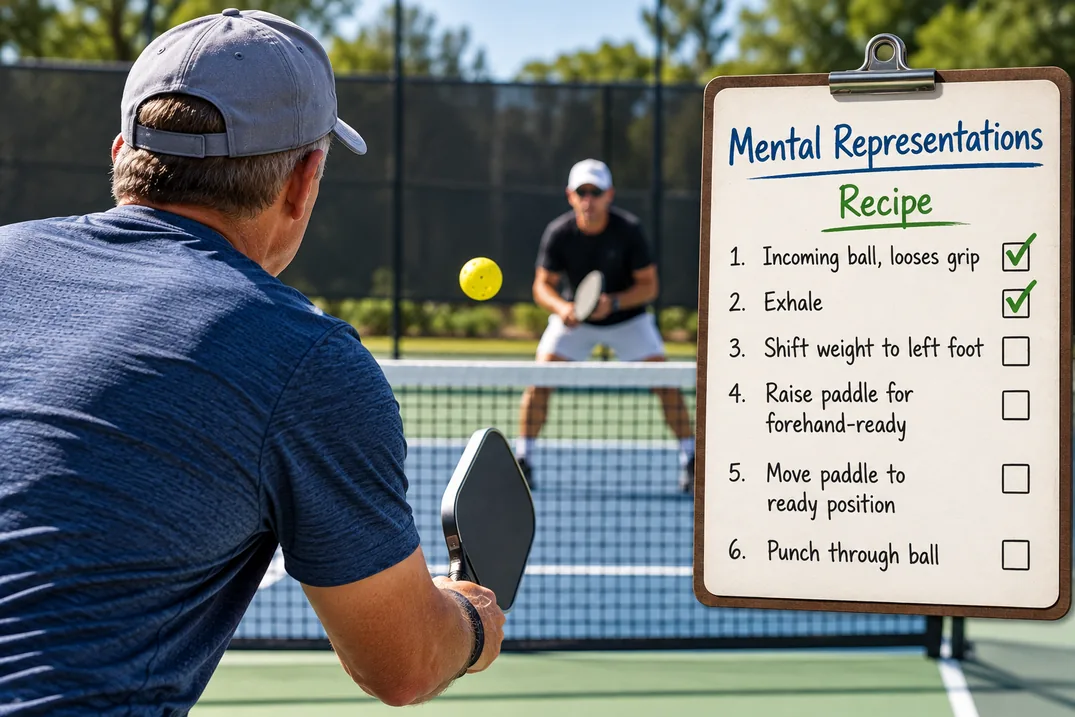
When learning to play pickleball, there are many skills you have to learn. One example is the serve. It is perhaps the easiest shot you have to hit, although for some players it can be much tougher. But for the sake of argument, let’s use the serve.
To be able to hit a serve, you have to know more than just how to hit it.
More Than Knowing How
Knowing how to hit a serve is not enough. You also have to be aware of all the possible issues that could affect it. How will the wind affect the ball? Are you playing with an indoor or outdoor ball? Where are your receiving opponents standing inside the court? There could be twenty or more variables that can affect the outcome.
Knowing how to do something is important. Understanding all the associated variables and how they can affect your serve are processed in the mind. The mind uses dynamically stored physical and symbolic formats called Mental Representations.
The Recipe in Your Mind
Mental Representations govern everything we do—brushing our teeth, taking out the trash, and driving to the grocery store. Whatever we are doing, there is a recipe for knowing how to do it. However, knowing how to do it is not everything you need to know to get it done. There can be a variety of issues that get in the way.
We have to know how to deal with those issues because the next step could change, and we have to accommodate that change to get the task done.
Here is a simple example. Let’s say we want to drive to the store to pick up a loaf of bread. To start the process, whose car are we going to drive? Or will we take a bus, subway, or helicopter? Next, which route will we take? Do we need keys? Will we use our smartwatch, phone, credit card, or rocks to pay for the bread?
We have to decide what to do about all of these issues—and more—and we haven’t even walked out the door.
There is a lot of controversy surrounding this extremely complex structure known as Mental Representations. We are going to look at it through the IT Guy Pickleball lens and understand how it works with pickleball.
Building the Pickleball Connection
Mental Representations require adding other skills to your shot-execution repetitions. Practicing shot repetitions alone will not get the job done. Repetition will improve your body mechanics; however, you also need to build the ability to be in a position on the court, recognize what is happening, and make a good decision before making a good shot.
Good decisions are built by increasing the number of tools in your storage cabinets of experiences, Mental Representations, and Situational Awareness. When you are playing full-speed games, you need to know what to look for.
What Are You Looking For?
Here is a short list of examples:
- Did my opponent put spin on the ball, or did they hit a dead drop?
- Am I going to hit the ball out of the air or let it bounce?
- Am I going to hit it? or Let it fly when it's above your eye!
- Do I want to hit a probing shot, and what kind?
- Can I attack because my opponent is off-balance?
- Where is my partner, and how are they playing today?
Mental Representations help us do so many things without thinking about them. We see, we adjust, we attempt, we adjust again as much as necessary, we complete, and we do it again.
Imagine how you could play pickleball if you built specific shot Mental Representations that you could use whenever needed—automatically.
Seeing the Possibilities
For instance, you’re playing doubles and your opponent hits a wide serve, pulling you off the court. As you are running to the ball, you can see a variety of shots you could hit:
You complete this shot while planning your next one using your Situational Awareness observational skills—knowing the possible angles of return stored in your Mental Representations vault.
Having these skills gives you more time to recognize more details and make decisions earlier. That can really speed up the thinking part of the game and, virtually, slow down the playing part of the game, giving you more options.
The No Man’s Land Gambit
I am sure that if you are an avid player who plays at least twice a week, you have been caught in the No Man’s Land Gambit.
If you are not aware of the name or what it is, this is a situation when you and your partner are stuck in the transition zone, or No Man’s Land, as most players refer to it. Your opponents are at the NVZ, or Kitchen, line. You know you have to escape and get to neutral or up to the Kitchen line.
If you have had this experience and built a Situational Awareness pattern for it, you will know what to do. If you don’t, here are the steps and thoughts that can get you to a safe, neutral place.
First, you need to prepare your body and paddle by getting low. Next, you need to hit a bump drop shot into the kitchen, aiming for a target six to ten inches inside the NVZ line.
If the shot is a little high, you need to wait in the transition zone until you can hit the correct shot. Once you hit the correct shot, you can advance to the NVZ line, get back to neutral, and start probing your opponents until you create an off-balance situation where you can attack.
The last two paragraphs have given you an example of a situation that may take only 10 to 15 seconds to play out. But the Situational Awareness and Mental Representations involved are literally thousands of interactions and thought processes, built on hours of off-court research, clinics, on-court practice, and match play.
Playing With an Active Mind
Every time you are on the court playing pickleball, you should be playing with an active mind.
An active mind is one that is observing and analyzing information. This will increase your Situational Awareness and build stronger Mental Representations.