
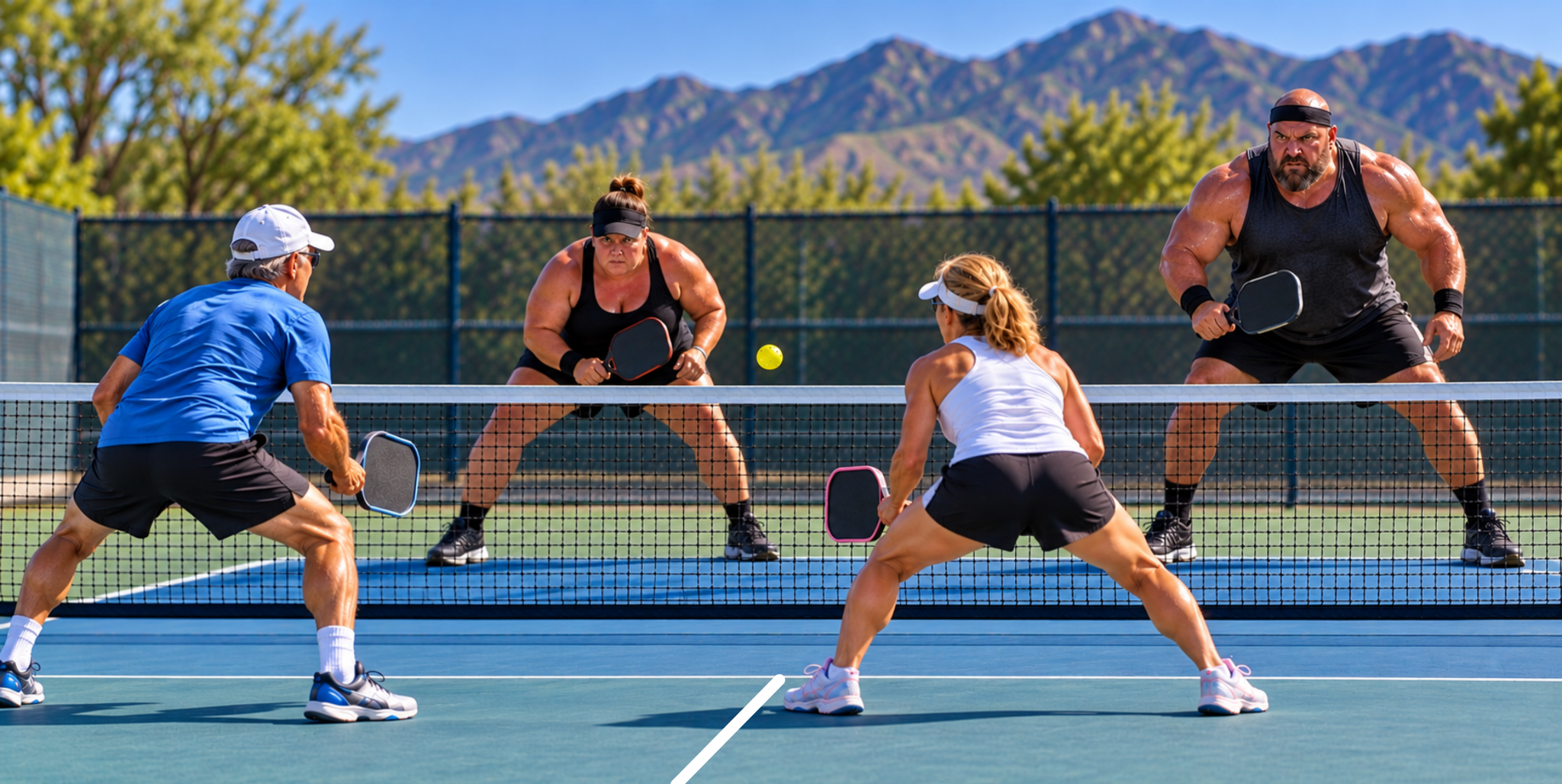
Understanding the Banger’s Advantage
Most players hate to play bangers and rightly so. It seems as though bangers want to take your head off. In my experience at the 3.25 to 4.0 level, bangers have not learned the slow, soft-touch game because they've had more victories than losses. That's because most players at this level don't know how to handle bangers. So, instead of you and your partner getting freaked out and running for cover, this is your opportunity to learn how to reset your mental perception and know how to handle bangers.
Tai Chi Pickleball teaches you how to not fight the game. Instead of meeting force with force, we absorb it, redirect it, and wait for our opponent to create the next opportunity to attack. As your Situational Awareness grows, court actions seem to slow down. You become consciously more aware of the small details, enabling you to recognize and respond to your opponent's forceful shots. One of the basic tenets of Tai Chi Pickleball is Absorb and Redirect, especially when your opponents are hitting bombs from the baseline and you're at the NVZ line. Absorb and Redirect also works when you're in a firefight at the net, but we'll get into that situation a little later.
If you attempt to fight fire with fire, this is a situation where you lower your chances of winning the rally. You are trying to hit very difficult shots to compensate for the speed of the incoming ball. Let's consider the speed of the ball for a moment. Average recreational players hit shots, groundstrokes and volleys, between 25 to 40 miles per hour. That works out to approximately 36 to 58 feet per second. When you consider how quickly the ball travels across a pickleball court, you begin to understand how little time you have to react. That's why developing Situational Awareness and Mental Representations is so important. The earlier you recognize what your opponent is about to do, the more time you have to prepare your response. Instead of panicking when a banger hits another bomb, you're already prepared to handle it calmly.
Preparing to Absorb and Redirect
Using Absorb and Redirect strategies against bangers hitting from the baseline is a situation where you actually have an advantage. You've got time to set your paddle, grip, and stance. Take a quick deep breath, exhale slowly, and relax whenever time permits. Through Situational Awareness, you recognize your banger opponent setting up for a drive even before the ball bounces on their side of the net. Your Mental Representations help you prepare and execute your shot. During a firefight at the NVZ, however, everything happens much faster, and there may not be time for that deep breath. That's why learning to recognize situations early and remain relaxed is so important.
Choosing the Dead Drop or Scorpion Shot
IT Guy Pickleball would like you to know—you have two shots, maybe more, that you can use in this situation. One is a dead drop into the kitchen, and the other is a scorpion shot. Which one you choose depends on what you recognize about your opponents. If they're a little slow moving forward, drop the ball into the kitchen and force them to come get it. If they're quick and aggressive moving forward, consider using a scorpion shot, directing the ball with angles and depth to keep them back.
First shot, preparing for a dead drop into the kitchen. Through Situational Awareness, you've recognized that your opponent may be slow moving forward, off-balance after hitting a powerful groundstroke, or showing another weakness you can exploit. Use a soft grip to absorb the incoming power and drop the ball into a kitchen target. This forces your opponent to move forward, potentially creating an off-balance, panicked situation that results in a cream puff setup. You calmly defuse the bombs and use your opponent's power to probe for the next opportunity to attack.
However, if they are fast and can get in then DO NOT invite them into the kitchen. You are begging them to join you in a firefight. If you invite your opponents to join you at the kitchen and you get into a firefight, and you have not yet built your reset volley skills, then you are elevating their chance to win the rally to a coin flip, a 50 - 50 chance.
Choice number two is the scorpion shot, used with a strategy IT Guy Pickleball calls the "No Man's Land Gambit." Both the dead drop and scorpion shot begin from the same ready position, making it difficult for your opponents to recognize which shot is coming. The dead drop uses a soft grip and minimal paddle movement, while the scorpion uses a tighter grip and more paddle movement after contact. With the scorpion, you can use angles and depth to keep your opponents pinned in the transition zone or at the baseline. Your objective is to keep them in a defensive position until they over-hit, mishit, or net the ball.
Building Your PAQ Toolbox
Most players are focused on playing the game instead of looking at how the game is being played. What I mean by that is many players are primarily concerned with getting the ball back over the net. But what about everything else happening on the court? Where are the four players positioned? What are your opponents doing, and what are they preparing to do? How are the players positioned in relation to the ball? As you develop your PAQ Toolbox, you begin recognizing more of these situations and using that information to make better decisions. Instead of observing what's happening, the player focused only on getting the ball back is panicking… OMG! The ball is coming, and it is soooo fast—now what? Kind of like Chicken Little playing pickleball… every shot would be—"The sky is falling, the sky is falling!!!"
As your PAQ Toolbox grows, the core philosophies of Tai Chi Pickleball help guide your decisions on the court:
- Stay Balanced.
- Read Your Opponent.
- Absorb and Redirect.
- Probe Without Forcing.
- Wait For Imbalance.
- Attack From Stability.
- Expect the Unexpected.
Bangers will often show you signs of imbalance when they over-hit the ball. They put so much effort into their shot that they lose their balance or struggle to recover their court position. Through Situational Awareness, you recognize these moments and look for opportunities to attack. But remember, recognizing an opportunity doesn't mean you must attack. Reading your opponent gives you the information to decide whether to attack, probe, or wait for a better opportunity.
Beating a banger by out-banging them is not a good strategy. Bangers often win because they create situations you're not prepared to handle. Their speed and power catch you by surprise, forcing you to react instead of recognizing what's happening. But as your PAQ Toolbox grows, those situations become more familiar. You begin recognizing their intentions earlier, preparing your response, and taking away the advantage they once had.
Putting Absorb and Redirect Into Practice
When you recognize a banger setting up for a groundstroke bomb, here's how you prepare to absorb and redirect their power into a dead drop:
- Get into your ready position.
- Sit into your ready position a little deeper than normal.
- Take a quick deep breath when time permits.
- Loosen your grip.
- Watch the ball as it approaches.
- Position your paddle in front of the incoming ball.
- Gently bump the ball toward your kitchen target, moving your paddle forward approximately one inch.
- Watch the ball drop into the kitchen as your opponent shrinks.
- Because you won the point so easily!!!
- That's being a Tai Chi Pickleball player!
Fighting force with force is not our objective. Our objective is to use our opponent's force through Absorb and Redirect to control the game. So, read the situation, set up, Absorb and Redirect. That's a strategy with "Winner!" written all over it!